| |
| |
|
|
|
 |
|
Concept for
intermedial |
|
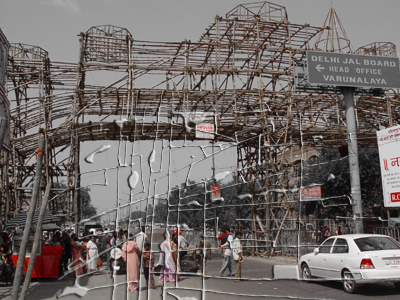
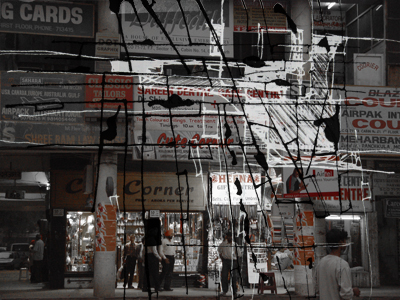
The dissolution of the secret between the contrasts of pulsing life in public and private contexts turns defined rooms into intermediate spaces and open structures that seemed so familiar into spaces that seem untouchable and worthy of protection.
Modern techniques of story-telling and reporting meet existing, developed structures, they enlighten them or focus in a manipulative way up to the point of absolute reduction.
Temporary situations burn themselves into walls and living objects appear in new perspectives without entering or leaving the intermediate spaces
Question:
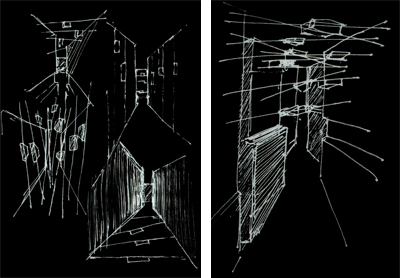
Rooms are volumes, defined by their borders. But how are intermediate spaces defined?
First answer:
They are everywhere, they leap to the eye, they conquer rooms, they fulfill needs, they allow for innovations, and some of them get established and can hardly be perceived anymore.
But are they the same everywhere, or, what makes the differences?
To what extent is our horizon too European concerning their perception and use?
Preparation:
Reflection of previous journeys:
. The loneliness and the cultural heritage of the Inca in South America (5 month 1998)
. Europe with the culture that first formed me (29 years)
The conclusion that a further perspective is necessary to find answers:
. The search of the fullness, the abundance, the incredible denseness of human beings,
. cultures and social systems in an economically upcoming country with an apparent
. contrast between rich and poor
. India, the biggest and most beautiful 'turd in the world' (8 month)
Journeys through India:
I have parted on my own initiative for a 5-month educational journey to India.
I cruised the country mainly on bicycle, but also on train.
I decided to travel like this, since my previous journeys showed me, that this is the best way to get into contact with the locals. You are not treated as a tourist, but get involved into conversations, and your interest in the country, the culture and the people is taken seriously.
This proved true also for this journey. I got a deep insight on the cultures, the people, the individual classes, and income groups. I saw the differences between the cultures, but also between the rich and the poor very clearly. I slept in the shed of a simple peasant and in the house of authors and producers of "bollywood" films. I also celebrated Christmas and New Year with them. I got involved into discussions about religion, history, art and culture. I heard the most different perspectives that I have ever heard in one single country.
Unfortunately the female perspective was hard to get since India has still a social system that is mainly dominated by men.
New questions:
On this research for impressions, similarities and contrasts, for beautiful and also for unpleasing images more concrete questions concerning intermediate spaces emerged:
. How do intermediate spaces arise?
. Where do they lead?
. Do we need them?
. Who benefits them?
. Can we capitalize them?
. What is their meaning for architecture?
. What happens when we suppress, purge or commercialize them?
. Where are the differences to Europe, to the rest of the world?
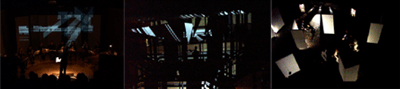
Working hypothesis:
- Since I cannot answer all questions I will have to communicate the differentiated comprehension that I gained during my detailed research.
- The work should be thought provoking, since only individual awareness and perception of the intermediate spaces reveal their function and quality. Only this way the viewer can grasp the hidden potentiality.
- This is not only interesting for the architects at haw Hamburg, but also for their colleagues in India.
- Actually the conscious or changed perspective on intermediate spaces brings profit to everybody, even when it provokes more questions than answers.
- Contrasts are necessary for a clear perception. Therefore, something new should be set in relation to something that already exists.
- Only the discourse and the transfer into other areas will make the work effective. Thus, the cultural exchange is an inherent part of the work, and further performances in other cities will be necessary.
- A performance with an expansive installation, animated projections and music seems the most appropriate means to realize this and to break conventional perspectives.
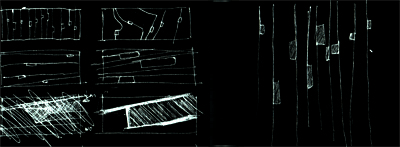
Concrete idea:
Since the project treats on spaces it should be set in these spaces.
Since the street is the biggest part of the spaces in India, it seems the most convenient space for the performance.
Furthermore it is important for me to show the contrast between old and new structures as well as the contrast between rich and poor, and between the western-oriented and the traditional.
My research has shown that these contrasts are most evident in Bombay. Therefore I decided to make my performance in this city.
The performance should break up conventional perspectives and develop a new perspective for the space. Therefore the performance should take place in a space stage and not in a picture frame stage like in cinema or classic theater. I would like to mad an installation on a truck that drives through the streets of Bombay and shows beamer projections.
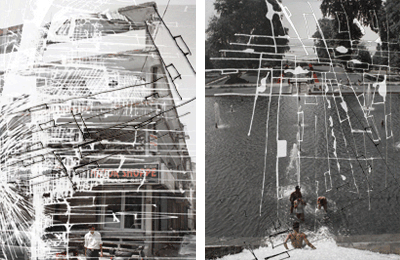
Since only contrasts allow perception I will change the familiar image of the space by means of the installation and the projection. I will focus on certain elements, implement foreign objects, or generate a reduced perception of the usual. When the truck comes to a halt, interviews will show the different perceptions. Afterwards, the abstract structures of the space and the inhabitants will speak for themselves.
A music project will accompany my work. This will be composed and produced by Arun Gauri, a composer of modern music who lives in Germany but comes from India. He will collaborate with the sound designer Thomas von Peskatore.
The premiere will take place in Hamburg and will later be transformed to India. Probably there will be a co-operation with musicians from India.
This synthesis of music and animation will create a complex and fully new image of the space, which will be elaborated in a performance in Hamburg.
The result will be many different perspectives on this work.
. Passengers
. Residents
. Traffic
. Viewers that follow in cars will observe and will be involved.
. With a small latency the people will be informed by live transmission on Internet
. Later it can be viewed as a recording at the exhibition at the hcu-Hamburg
. and at the KuBaSta gallery (Raum für Kunst Bauen Stadtentwicklung).
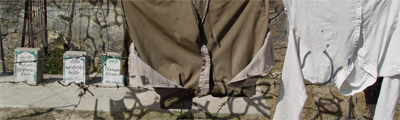
A clear objective:
The viewers/spectators will be invited to take the presented images, situations and the changed perception of the space as a starting point for their own experiences. They should create their own stories and gain a permanent impression for their own private lives. The simplest case will be that the viewer will gain an experience that he will forget, but in other cases he will hopefully discuss his experiences and take profit of the newly gained perspectives.
Motivations:
intermedial is the title of the project. The aim is to build a bridge _ to assure intercultural exchange with modern modern_ media like reports and presentations.
I decided to realize my diploma this way, since
it is important for me to show the complexity of perception and to
emphasize that architecture is interdisciplinary and has an evident
sociocultural duty.
This diploma/thesis is the consequent continuation and connection of my
artistic and my architectural ambitions.
For the student competition
mme mobiler multifunktionaler einraum of the Handwerkskammer Hamburg I built
a sculpture that deals with spaces and especially their
change.
My last projects at the university
and the shows I attended as tutor at the haw-Hamburg were
performance shows.
The projects mando/syarch, affecte, strips and vertex were
interdisciplinary projects, sometimes with musicians and sometimes
with dancers or with both. They always showed a change or shift of the
visual and auditory habits, where an expansive sculpture and
animations served as means of expression.
Furthermore, as a prelude for intermedial, I exposed
light boxes with the title "stadtlandschaften" (cityscapes) at the KuBaSta gallery (Raum
für Kunst Bauen Stadtentwicklung) in Hamburg.
The concept of
intermedial is the consequent prosecution of these works. This project is not bound to a certain space, but deals with the
environment, explores it and puts it in
a new perspective.
back
|
|